Ardent I tank
The FV-FT 4082 Ardent (Later Ardent I) is an Aldren main battle tank (MBT) that saw service in the Aldren Army from 1980 to 2001. The Ardent was in some ways a further development of the former Aldrenian main battle tank Resolute, and is based on the same hull and chassis. The Ardent was replaced by the Ardent II as it entered service in 1991, only 11 years after the tank was first placed into service. The Ardent II was only placed into service in a limited pre-series production, however, and only around 50 units were in official service before the Ardent I’s full replacement in 2001. At its peak of service, around 510 Ardent Is had been in active use by the Aldren Army.
A majority of the Ardent I fleet was subsequently shipped to Cendara, where it remained in service until 2015. The vehicle was locally redesignated as the Kudu. The vehicles received were of varying improvements, mostly Mk. 5 and Mk. 8 tanks. The vehicles received various Cendaran upgrades before they were replaced with the locally developed Suricate main battle tanks and Jackall wheeled tank destroyers.
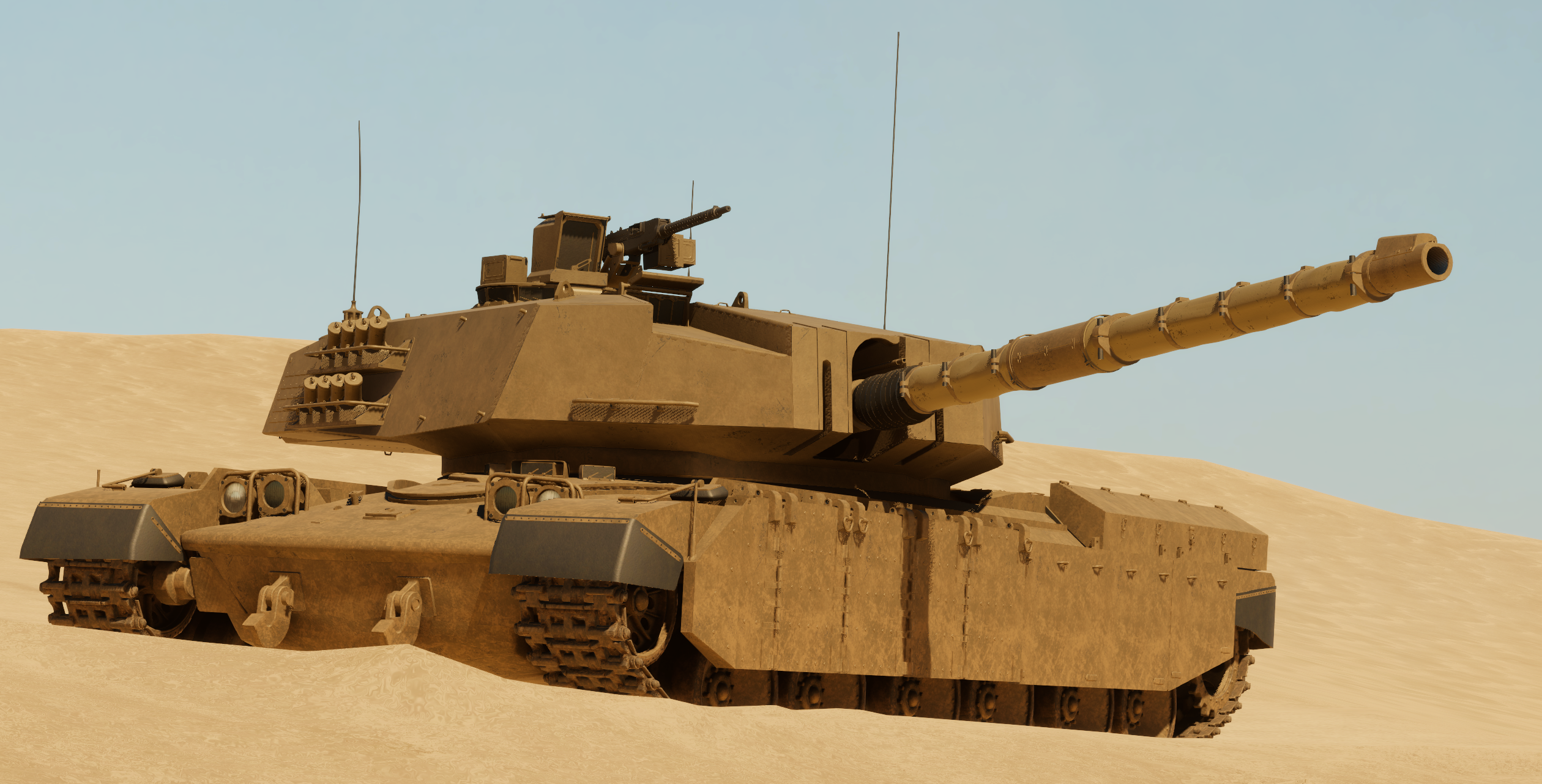 Ardent Mk. 5 during the Kharaz Crisis in 1994.
Development
The Ardent programme, initiated in 1975, had its roots in a series of Imperial Staufford Defence Science Institute (ISDSI) studies of the Resolute main battle tank, which had by then been in service for 9 years. The Resolute was reputed as outdated rapidly after it had entered service, with lackluster performance, numerous teething issues and problems that would remain with the Resolute until it left service. These issues became especially clear to Aldrenian armoured crews, as the imported SA-40 tank that operated alongside the Resolute often outperformed the natively developed design.
Designs were drafted for potential upgrades for the Resolute, including addon composite armour, improved powertrain, improved optical and fire control systems, as well as potential replacements. Around 1970, Standard Arms had begun a private development venture while cooperating with ISDSI engineers called the SA-60 programme. The SA-60 design was equipped with a number of advanced features such as newly developed hydropneumatic suspension that could manipulate the height and angle of the tank’s hull and armed with a Røros Defence developed 142 mm gun/launcher. Only one prototype was ever produced of the vehicle before the project’s end in 1972, although its design would influence the ISDSI’s efforts into the Ardent development programme.
Ardent design programme and prototyping
The Ardent design programme would be a cooperation between a number of groups, such as the Imperial Ordnance Establishment (IOE), ISDSI, Hawthorne & Beau and the Army Armour Corps (AAC). Initial development would focus on static testing, and it was later established the design would most likely be a total replacement of the Resolute, with new chassis and armour systems. It was during this stage of development ISDSI would first model their Staufford armour layout, which would see use in the Ardent upon completion, as well as international usage in tanks such as the Richelieu.
In 1976 the Aldren Army would undergo significant restructuring due to budget cuts, leading to the development programme being scaled down and new plans having to be drafted. It was decided the Ardent would reuse the Resolute’s hull and chassis, instead replacing the existing turret with a completely redesigned model, which would replace the monolithic cast homogeneous armour (CHA) turret with a turret armoured with Staufford composites and equipped with improved fire control and traverse mechanisms.
Much of the Ardent’s design doctrine was directly inherited from the Resolute. The Ardent design focused mostly on infantry support instead of anti-armour combat, although the improved technology of the Ardent design allowed for much longer distance engagement, something which accounted for both of the important ‘combat zones’ designated in Aldren / Aldmark combat doctrine.
For prototyping older hulls would be used, most notably the hull for a prototype Resolute tank that mounted torsion bar suspension as opposed to the finished model that mounts Slow Motion suspension. Later one Resolute Mk. 2 would be pulled from service and retrofitted with an experimental Ardent turret for live-fire and mobility testing. Multiple static tests were run by the ISDSI and IOE to test armour and armament. It was decided the tank would mount the ICO L496a2 cannon, an improved version of the rifled 120 mm gun mounted on the Resolute. The design also inherited the coaxial ranging gun.
Design
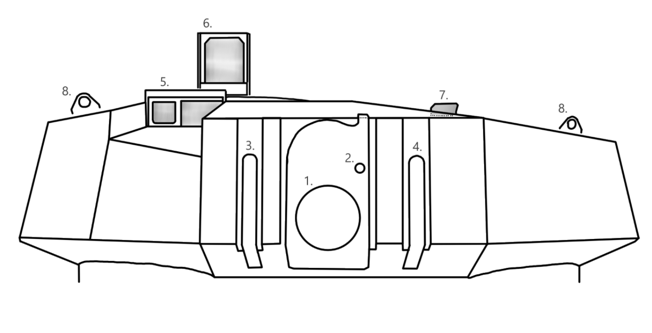 Illustration of the front of the Ardent I turret.
- - Cannon
- - Spotting Rifle
- - Backup sight slit
- - Coaxial machine gun slit
- - Gunners primary sight
- - Commanders panoramic sight
- - Loaders episcope
- - Crane hooks
Armament
The design mounts the ICO L496a2 cannon, otherwise called FP120 the or simply the L/49.6, as it is 49.6 calibres in length. The barrel itself is 5000 mm or 41.6 calibres long. It is a rifled 120 mm superficially similar to Verbandt’s RGE-121 C1 that saw use on the MV50 Rochester and Richelieu S1 tanks. The gun is rifled as opposed to smoothbore as it provided increased performance for HESH ammunition, although decreasing the effectiveness of the armour piercing ammunition.
Mounted above the main breech is the semi-automatic RL5S spotting rifle, which fires specially matched 12.7×99 mm spotter rounds from detachable 8-round box magazines. The system is integrated into the gunner’s sighting and ballistic computer, allowing rapid fall-of-shot correction during target engagement. The RL5S is an evolution of the manually operated RL4S used on the Resolute, which relied on 3-round clips and was slower to operate and reload.
The inclusion of a spotting rifle on the Ardent was largely a legacy feature. A fully effective laser rangefinder was not introduced until the Mk. 3 model, but the RL5S was retained for reliability purposes; its removal would have had little impact on armour performance or reliability. Although a retrofit replacing the spotting rifle with a coaxial GPMG was designed, no Ardent model was ever fitted with this modification.
Other secondary armaments include the coaxial L80 7.62×51 mm machine gun, and a commander-controlled 12.7×99 mm CZ127 Bustard heavy machine gun mounted to the commander’s cupola.
Armour
The armour of the Ardent is likely the part that has received the most criticism over the years. The tank inherits the basic steel spaced armour layout of the Resolute, and has multiple significant armour weak points, most prominently the mantlet and turret ring, along with a very large shot trap. This feature of the Ardent’s design is a consequence of the Resolute’s tall engine deck. It was decided the Resolute hull would not receive an engine modification to facilitate an improved armour layout, as it would set the project significantly over-budget. The Ardent’s hull did however receive a composite armour upgrade in the Mk. 3 model and onwards, where the lower frontal plate (LFP) would be replaced with a new cast monobloc structure and a composite armour layout internally. The Ardent Mk. 3 would also see the introduction of NERA sideskirts that provided additional protection on the frontal arc of the vehicle.
The Ardent’s thick Staufford composite armour blocks do however provide enormous protection against chemical energy (CE) attacks, as well as significant defense against kinetic energy (KE) long-rod armour penetrators. The Ardent I’s composites would prove capable of defending against increasingly modern tank weaponry even throughout the 2000s and early 2010s.
The Ardent features effective NBC protection and sealing. In terms of passive protection, it mounts G11 smoke mortars with anti-thermal contents. Some prototypes have reportedly been mounted with anti-missile dazzlers, similar to that mounted on the MV50a1 CERUS.
Layout and internals
The Ardent has a spacious turret interior. The ammunition is two-piece, with the majority of gun powder being placed in the bustle. The first stage ammo rack is placed in front of the loader, with additional shells placed on the turret walls around the loader’s position. Ammo is also stored in the frontal hull compartment and underneath the turret, although on later models frontal hull racks are removed and replaced with either wet ammo storage or full fuel tanks.
The gunner’s primary sight (GPS) has both day and night/thermal channels with 3 stages of magnification. It was a relatively sophisticated system for the time, allowing for effective target engagement at longer distances. The first stage of magnification on the day channel has a very broad field-of-view, allowing for effective engagement of close-range targets in infantry-support scenarios, increasing the gunner’s personal combat awareness.
Usage history
In 1984, the Ardent I participated in the SATA Armoured Evaluation Trials, a high-profile multinational tank competition intended to showcase the latest main battle tank designs and test their capabilities in simulated combat conditions. The event brought together cutting-edge vehicles from the SATA nations, including the Richelieu S1 and S1a1 from Verbandt, Auvorician PM2 and PM3, and upgraded MV52 Tirith tanks from Marlova.
The Ardent I had recently received its Mk. 3 upgrade, with significant improvements to armour and cross-country maneuverability and performance. Despite this, it was still based on the aging Resolute platform, and it struggled to match the other vehicles in the competition. It was slow and less agile than the fast PM3 and Richelieu tanks, especially when navigating the obstacle-heavy courses laid out in the competition. In firing trials it proved very effective, although its rifled gun and APDS / APFSDS rounds did not match the armour-penetrating performance of its peers.
By the conclusion of the trials, the Ardent I had placed near the bottom of the rankings. Observers described the results as a disappointment, though Aldrenian officials cautioned that competition outcomes did not reflect its effectiveness on a real battlefield. Nevertheless, the evaluation highlighted several areas for improvement, directly influencing subsequent upgrades.
Kharaz Crisis
The Ardent saw its first major combat during the Kharaz Crisis of 1993–1995. Initial deployments included both Mk. 5 and Mk. 7 models, with crews drawn primarily from Aldrenian armoured divisions. The vehicles had not yet seen real combat, and would initially struggle in the harsh desert terrain which it was not originally designed for. A number of these issues were resolved during the duration of the war, with Cendaran armoured divisions helping the Aldren tank crews inexperienced with desert warfare on the ideal strategy and operation of the vehicles in the desert terrain. Cendaran experience with the Resolute directly informed Ardent operational strategy, something which is reputed to have significantly sped up the Aldren Army’s climatisation to the desert war.
The Ardent was superior to the First Alliance-designed tanks in service of Kharaz, those being the v76-2 and v82, as well as the reserve v62 and v54 vehicles used in the later stages of the war. The v76-2 and v82 used by Kharaz were imported vehicles, and to base specifications. The v76-2 and v82 both mounted sophisticated fire control systems for the time, but they had since become outdated. While the Ardent was based on an antiquated hull, the fire control system and thermal imager proved very effective in direct tank-on-tank combat.
Very few Ardent tanks were recorded to have received high-caliber fire, and even fewer suffered significant damage or losses. Six Ardent tanks were lost, all of which were Ardent Mk. 2 vehicles. Three were lost during an evacuation and then destroyed by the Coalition air assault to avoid capture, and another three were lost from blue-on-blue incidents.
Reputation
The Ardent I developed a mixed but generally respectable reputation both domestically and abroad. Among Aldrenian crews it was regarded as a rugged and dependable vehicle that, while lacking refinement, could endure demanding conditions and sustain heavy use with minimal mechanical failure once early production issues were resolved. The turret was very spacious, with crew comfort as an important design focus in the design, something which proved popular among crewmen who had otherwise worked in the more cramped and conservative Resolute and Vanguard main battle tanks. Despite the tanks' otherwise aging design elements, the gunner’s and commander’s personal sights and the integrated fire control system were incredibly accurate, outpacing First Alliance technology. Nonetheless, the Ardent’s combat record and longevity in foreign service contributed to a perception of it as a solid, workmanlike tank that rewarded competent crews and diligent maintenance.
Ardent Mk.1 to Mk.9, Overview
|
Item |
Mk. 1 |
Mk. 2 |
Mk. 3 |
Mk. 4 |
Mk. 5 |
Mk. 7 |
Mk. 8 |
Mk. 9 |
Mk. 6 |
|---|---|---|---|---|---|---|---|---|---|
|
Date |
1980 |
1981 |
1984 |
1984 |
1985 |
1986 |
1990 |
1992 |
1985 |
|
Crew |
4 (Commander, Loader, Gunner, Driver) |
||||||||
|
Hull armour |
CHA and spaced armour lower frontal plate. |
Upgraded composite armour lower frontal plate. |
|||||||
|
Roof machine guns |
Commander-controlled 12.7×99 mm CZ127 Bustard |
Roof L80 7.62×51 mm GPMG |
|||||||
|
Coaxial Weaponry |
7.62×51 mm |
7.62×51 mm and additional 12.7×99 mm added unto trunnion assembly |
|||||||
|
Commander’s cupola |
M12 Rotary with EC6 optic |
M12 Rotary with EC9 optic |
M16 static crown cupola with observation station |
Modified M12 Rotary |
|||||
|
Gunner’s sight |
Gunner, Tank optical sight, Laser rangefinder, No. 9 Mk. 1 |
Gunner, Tank optical sight, Laser rangefinder, No. 9 Mk. 2 |
|||||||
|
Combat weight |
52 long tons (58.5 short tons; 53 tonnes) |
53.6 long tons (60 short tons; 54.5 tonnes) |
57 long tons (64 short tons; 56 tonnes) |
53 long tons (59.5 short tons; 54 tonnes) |
|||||
|
Engine |
DCV12A / L6 mk. 1 |
DCV12A / L6 mk. 2 |
Glovinn CVE12 / L8 mk. 1 |
Glovinn CVE12 C300 / L8 mk. 2 |
|||||
|
Engine displacement |
19L |
26 L |
|||||||
|
Transmission |
Francis Defence Limited MT20 (3 fwd, 2 rev) |
||||||||
|
Power output |
800 hp |
900 hp |
1150 hp |
||||||
|
Suspension system |
Slow Motion suspension bogie(s) |
||||||||
|
Maximum speed (recommended top speed, on-road) |
48 kmh |
50 kmh |
57 kmh |
60 kmh |
|||||
|
Fuel capacity |
1400 L |
1500 L |
1700 L |
||||||
|
Operational range |
400 km (road) |
440 km (road) |
460 km (road) |
||||||
|
Width |
3.49 m (sideskirts) |
3.74 m (sideskirts) 3.45 m (sponsons) |
|||||||
|
Height (from ground) |
2.92 m (cupola, machine gun) |
3.18 m (cupola, panoramic sight) |
|||||||
|
2.44 m (roof) |
|||||||||
|
4.15 m (with radio antennas) |
|||||||||
|
Length |
7.31 m (hull) |
||||||||
|
9.78 m (gun forward) |
|||||||||
|
Turret rotation time (360°) |
12 s |
11.3 s |
11.6 s |
11.0 s |
|||||
List by marks
Ardent T1
20 training vehicles based on the Resolute Mk. 2 hull, inheriting the Resolute’s powertrain. It had a strengthened MT12 gearbox, reinforced exhaust box on the hull rear plate, and larger rubber-padded roadwheels mounted by widening the travel of the Slow Motion bogies.
Ardent Mk. 1
30 training vehicles based on the Resolute Mk. 3 hull. New roadwheels were mounted but the same scale as the Resolute’s as opposed to the roadwheels of the Ardent T1, mounting the new 800 hp (596 kW) L6 mk. 1 engine and MT20 gearbox. The chassis was strengthened and additional internal armour panels were added around the driver’s compartment. The Mk. 1 received a new storage rack on the rear of the turret, and a bustle net on the left side of the turret.
Ardent Mk. 1/2
Ardent Mk. 1 converted to Mk. 2 standard.
Ardent Mk. 2
First service / full production model of the Ardent. Minor modifications to the Mk. 1 design. Jerry can holders attached around the turret, additional loops, ladder steps and mounting points added to the roof and turret walls. Internal changes to increase crew comfort / convenience.
Ardent Mk. 3/2
Model of Ardent Mk. 3 without additional armour, retaining older cast LFP.
Ardent Mk. 3
Significant production upgrade to the Mk. 2 mounting a strengthened L6 mk. 2 engine producing 900 hp (671 kW), a new cast metal lower frontal plate along with a Staufford composite armour inlay in the hull’s originally spaced armour void, significantly increasing the tanks armour effectiveness against CE attacks. The tank also receives modular composite side skirts on the front half of the tank. The commander cupola is upgraded and given an improved EC9 commander’s primary optic. The tank also gains another 100 litre fuel tank increasing the tank’s combat range. The defensive smoke launcher arrays were changed, doubling the amount of charges from 8 to 16.
Ardent Mk. 4
Minor upgrade over the Mk. 3 with resolved teething issues from the Mk. 3, minor increases in armour effectiveness and powertrain reliability.
Ardent Mk. 5
Integrates new L8 Mk. 1 engine and further strengthened MT20 gearbox, producing a significantly more powerful 1150 hp (857 kW) capable of matching the engine power of contemporary battle tanks in 1985. The engine compartment is internally restructured although it is very visually similar from the exterior. Fuel tank layout was upgraded and given another 100 litres of fuel capacity. The Mk. 5 is the first model to gain a Muzzle Reference System (MRS), increasing the cannon’s accuracy.
Ardent Mk. 6
Experimental model based on the Ardent Mk. 3/2 hull used to test new potential urban combat-based improvements for the Ardent tank system. It mounts a modified version of the M12 rotary cupola and a coaxially mounted 12.7×99 mm CZ127 over the barrel. The tank is upgraded with the Mk. 5 engine and engine compartment but mounts the experimental CVE12 C300 or L8 mk.2 engine that would later see use in the Mk. 8, giving it greatly increased power. The tank lacks the Mk. 3s frontal composite, decreasing weight and improving mobility. Despite being a test model, 12 of these tanks entered service with the Aldren armoured forces.
Ardent Mk. 7
Minor upgrade over the Mk. 5 with resolved teething issues with the new powertrain along with an improved gunner’s optic.
Ardent Mk. 8
Mounts new M16 static cupola featuring larger episcopes on a taller mount. The cupola is placed on the roof of the tank with a cast metal plate. The cupola has a pivoting hatch with a spaced armour plate, as opposed to the earlier M12 cupola with a conventional hinged hatch. The Mk. 8 most remarkably mounted a large panoramic sight, named the ‘observation station’. This optic gives the commander significantly increased combat awareness capability. The viewer has day and night/thermal channels.
Ardent Mk. 9
Final production model of the Ardent I introduced in 1992. Adds internal anti-spall liners, laser-designator compatible optics systems and slightly uprated powertrain with increased reliability.
Variants and upgrades
EV-FT 4227 ARRV
Ardent I-based armoured Repair and Recovery Vehicle (ARRV). 24 were produced, based on the hulls of the Ardent Mk. 3/2 and Ardent Mk. 8/6.
EV-FT 4240 ABLV
Ardent I-based armoured Bridge Layer Vehicle (ABLV). 12 examples produced, based on the hulls of Ardent Mk. 3/2
Ardent Mine Clearer Vehicle
Ardent I-based mine clearance vehicle that saw extensive use in the Kharaz crisis.
Ardent Research, Science and Engineering Integration Demonstrator (RSEID)
Technology demonstrator based originally on a Ardent Mk. 3 that was used throughout the Ardent I’s tenure to test equipment and run scientific experiments. The RSEID was the first vehicle equipped with the commander’s observation station as seen on the Ardent Mk. 8. The RSEID would most prominently go on to be used to test ‘tank stealth’.
Ardent Kukri 30
Self-propelled anti-air (SPAA) based on the Ardent Mk. 4’s hull. The Ardent’s turret is replaced with a turret mounting two 30 mm cannons centrally and a radar on the rear.
Kudu 1a
Cendaran designation for models of Ardent I lacking frontal hull composites, i.e. Mk. 1 and Mk. 2 models. Very limited numbers of these models were exported to Cendara.
Kudu 1b
Cendaran designation for Ardent mk. 3 and mk. 4.
Kudu 1c
Cendaran designation for Ardent mk. 5 and mk. 7.
Kudu 1d
Cendaran designation for Ardent mk. 8 and mk. 9.
Kudu 1e
Locally developed Cendaran upgrade of its Kudu 1b and 1c tanks, upgrading all vehicles to a standard similar to that of the Kudu 1d / Ardent Mk. 8, but with a locally developed cupola and commander’s panoramic sight. The Kudu 1e tanks were mounted with imported Glovinn CVE12 C250 engines.
Operators
Current
Cendara - Reportedly 50 Kudu 1d and Kudu 1e models in service. Cendara has an unknown amount of 1d and 1e models remaining in storage, estimates range between 150-200 vehicles. Cendara has recently been searching for modern replacements, and the Kudu may leave service soon.
Former
Aldren - Had approximately 510 vehicles in service before its total retirement in 2001.
Image(s)
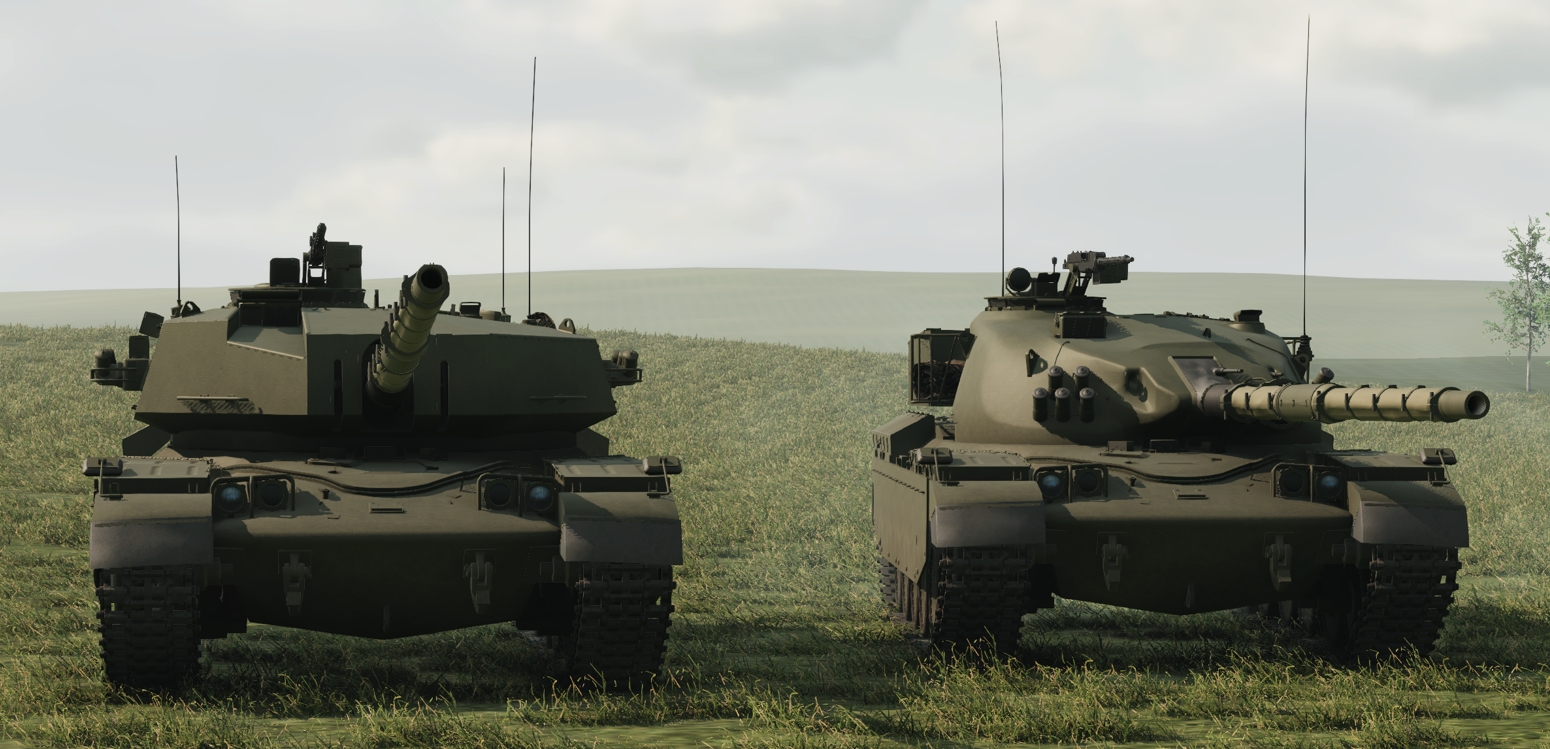 Ardent next to Resolute.
Writer's footnotes
The SA-40 was also designed to fit a 140mm long-barrel smoothbore gun.
This has been copy-pasted directly from a Google Doc with no additional quality control.